
 By
By 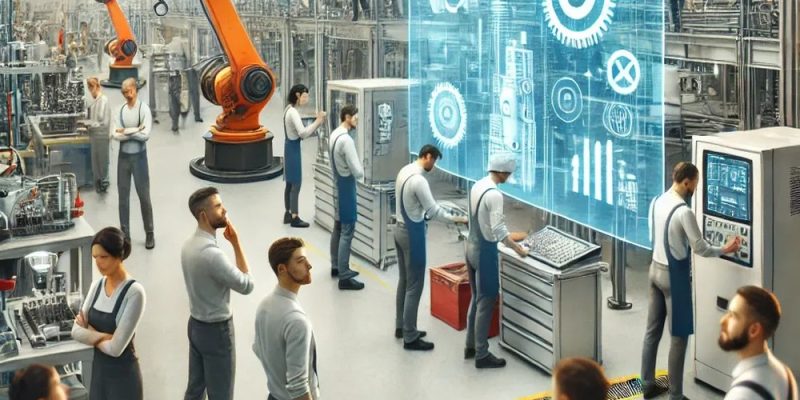
Manufacturing companies across multiple sectors are facing a persistent imbalance between labor demand and workforce availability. This is not a temporary fluctuation but a structural issue shaped by demographic trends, shifting skill profiles, and changing expectations toward industrial work. Production managers increasingly operate in environments where maintaining staffing levels is as challenging as meeting output targets. The consequence is a growing need to redesign processes in a way that reduces dependency on manual labor without compromising operational continuity.
Labor shortages tend to affect specific segments of production more severely than others. Repetitive, physically demanding, or low-perceived-value tasks are often the hardest to staff and retain. These roles typically involve machine tending, palletizing, packaging, or basic assembly operations. High turnover in these positions introduces instability, forcing companies to constantly retrain workers and adjust schedules. Over time, this erodes productivity and increases the likelihood of errors, particularly in processes that require consistency.
Automation as a response to workforce instability
Automation is frequently presented as a direct substitute for human labor, but in practice it functions more as a stabilizing layer within the production system. By transferring repetitive tasks to machines, companies reduce their exposure to workforce fluctuations. This does not eliminate the need for human operators, but it changes their role from direct execution to supervision and coordination. As a result, fewer employees are required to maintain the same level of output, and those who remain are positioned in roles that are less physically demanding and more cognitively engaging.
The impact of this shift becomes particularly visible in machine utilization rates. In a labor-constrained environment, machines often sit idle not because of technical issues, but due to a lack of operators. Automating loading and unloading processes allows equipment to run continuously, independent of staffing constraints. This increases overall efficiency without requiring additional capital investment in new machinery. The same principle applies to end-of-line operations, where automated palletizing systems can operate consistently regardless of shift availability.
Incremental automation and risk management
For many small and medium-sized enterprises, the challenge lies not in recognizing the value of automation, but in managing the risks associated with its implementation. Large-scale automation projects require significant upfront investment and can disrupt existing workflows. In uncertain labor markets, committing to such projects may appear counterintuitive. As a result, companies are increasingly adopting incremental approaches, introducing automation in specific areas where the return on investment is most predictable.
This staged implementation allows organizations to build internal competence while minimizing disruption. Initial deployments often focus on well-defined tasks with limited variability, where automation can be introduced without extensive process redesign. Once these systems are operational, companies can evaluate their performance and gradually expand automation to adjacent processes. By analyzing how solutions are structured and deployed, decision-makers can visit the site to observe how modular tooling and standardized interfaces reduce integration complexity and shorten deployment cycles. This visibility into real-world applications supports more informed investment decisions.
Redefining workforce roles and skill requirements
Automation does not remove the need for human expertise; it redistributes it. As routine tasks are automated, the demand shifts toward roles that involve system oversight, troubleshooting, and continuous improvement. Maintenance managers, for example, transition from reactive interventions to proactive system management, focusing on uptime optimization and predictive diagnostics. Process engineers become responsible for configuring and refining automated workflows rather than designing purely manual operations.
This transition requires a corresponding shift in skill development. Employees must be trained not only in operating automated systems but also in understanding their underlying logic. The ability to interpret data, adjust parameters, and diagnose issues becomes more valuable than manual dexterity. Companies that invest in upskilling their workforce are better positioned to leverage automation effectively, as they can adapt systems internally rather than relying entirely on external support.
Automation as a tool for improving job quality
An often overlooked aspect of automation is its impact on job quality. Tasks that are physically strenuous, monotonous, or associated with high injury risk are prime candidates for automation. By reallocating these activities to machines, companies can create safer and more attractive working conditions. This has a direct effect on employee retention, which is a critical factor in labor-constrained environments.
Improved job quality also influences recruitment. Positions that involve interaction with advanced technology and offer opportunities for skill development are more appealing to a broader range of candidates. This does not fully resolve labor shortages, but it changes the dynamics of workforce acquisition. Companies become less dependent on a shrinking pool of workers willing to perform repetitive manual tasks and more aligned with the expectations of a modern workforce.
Operational flexibility in uncertain labor markets
Labor shortages are rarely uniform; they fluctuate across time, regions, and specific roles. Automation provides a buffer against this variability by decoupling production capacity from workforce availability. Systems can be designed to operate with different levels of human involvement, allowing companies to adjust their operations based on current staffing conditions. In periods of acute shortage, automated processes can maintain baseline output, while in more stable conditions, human operators can be reintroduced to handle complex or variable tasks.
This flexibility is particularly valuable in industries with seasonal demand or high product variability. Instead of scaling the workforce up and down, companies can rely on a stable core of employees supported by adaptable automation systems. This reduces the administrative burden associated with hiring and training while maintaining consistent production performance.
From labor substitution to system resilience
The most effective use of automation in addressing labor shortages lies in its ability to enhance system resilience rather than simply replace workers. By integrating automated solutions into critical points of the production process, companies create buffers that absorb variability in both demand and workforce availability. This approach transforms automation from a reactive measure into a strategic asset.
Resilient systems are characterized by their ability to maintain performance under changing conditions. Automation contributes to this by providing consistency, reducing dependency on individual operators, and enabling rapid adjustments to process configurations. When combined with a skilled workforce capable of managing and adapting these systems, it creates a production environment that is both efficient and robust. In the context of ongoing labor shortages, this balance between human and machine capabilities becomes a defining factor in long-term competitiveness.








Comments